Choose phone repair tweezers around the component and the available access. An extremely fine tip is not always better, and a curved shape does not make a tool universal. Tip alignment, closing force and the material being handled all matter.
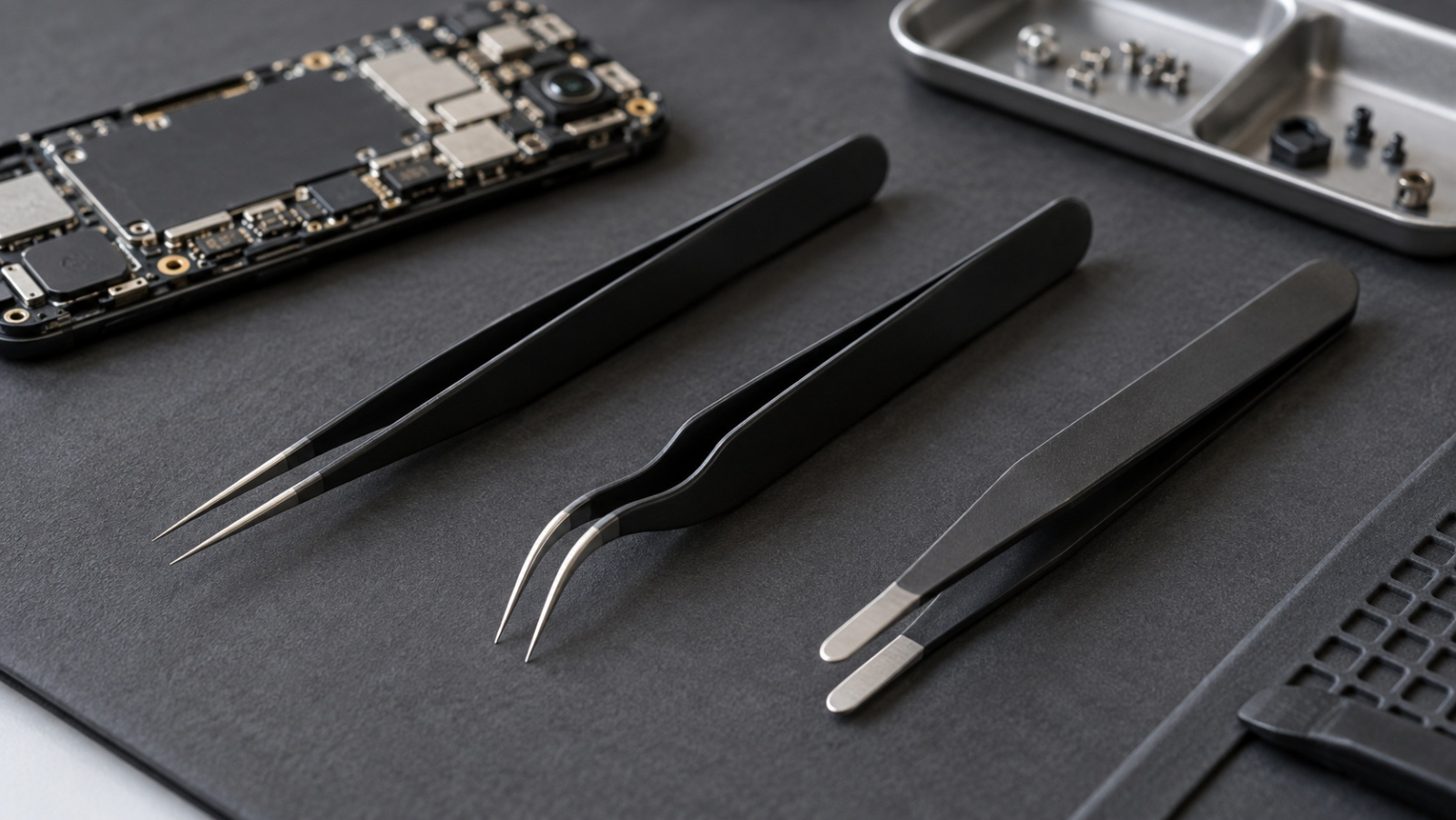
Straight, curved or rounded tips?
Straight tips are useful when there is a direct approach to the part and a clear view. One catalog example is the  Mechanic ESD-11 straight tweezersout of stock›. Assess the length and width of the working tips rather than overall tool size alone.
Curved tweezers change the approach angle and the position of your hand relative to the field of view. The  Mechanic ESD-15 curved tweezersout of stock› is an example. This shape may be comfortable under a microscope, but check that it does not hide the component or force contact with neighboring parts.
Compare rounded tips for tasks that do not require a sharp contact point. One example is the  Mechanic ESD-13 rounded tweezers2,81 $›. Suitability for films or soft parts depends on actual geometry and pressure, not the shape's name alone.
Check alignment before use
Under good lighting, slowly close the tips. They should not cross, shift noticeably or have burrs. Test their grip with a spare practice component of an appropriate size rather than an expensive customer part.
If a component slips, do not immediately squeeze harder. Contamination, an unsuitable contact area or bent tips may be responsible. Excessive force increases the risk of damage or the component springing out of the tool.
What ESD means in the name
ESD properties concern static electricity and should be supported by the specific product description. A black coating alone does not establish electrostatic properties. Even suitable tweezers work as part of an organized ESD-control system at the bench.
Do not confuse ESD control with electrical insulation. Metal tweezers can short adjacent contacts, so disconnect device power according to the service procedure before the relevant work. An ESD label is not permission to work on energized circuits.
Materials and specialist tips
For work near magnetic parts, check the alloy's stated magnetic properties. For plastic, ceramic or replaceable tips, verify temperature limits, chemical resistance and spare-tip availability. Do not apply one material's properties to every similar-looking tool.
A coating does not mean the tool can touch a hot soldering tip or remain indefinitely in a hot-air stream. Follow the manufacturer's operating limits.
Care without losing precision
Remove residues using a compatible cleaning method and store the tool dry. Protect the tips from striking neighboring tools. Fit any protective cap gently without bending the points.
Do not use precision tweezers as a lever to open enclosures or tear away adhesive. Recheck tip alignment after a drop. A tool with deformed tips should not return to precision work without assessment.
How many pairs does a technician need?
Start with the shape needed for your most frequent task. Add another when a different approach angle or contact area is genuinely required. A large set does not compensate for poor tip alignment.
Can I choose by the ESD-11 or ESD-15 number alone?
No. Check the manufacturer, SKU, geometry and specific description. At GSM-Forsage, compare specifications and current package contents rather than similar names alone.
Ideal-tek: an example of specified ESD tweezer coatings

 UA
 RO





The information below is required for social login
Sign In
Create New Account