Information
Devices for more convenient repair of equipment. — an informational article for technicians, service centers, and users, covering practical details related to choosing, using, and repairing electronics.
A comfortable phone repair bench is less about owning more gear and more about keeping each step of the job in order. A mat keeps screws and parts apart, a board holder frees both hands, fume extraction pulls solder smoke away from your face, and an organizer keeps drivers and tweezers where you expect them. Pick each accessory for the jobs you actually do, the size of your bench and the safety rules of your shop.
Which accessories actually help
| Accessory | What it does at the bench | What to check before you use it |
|---|
| Heat-resistant mat | Protects the bench top and gives you separate spots for screws and parts | Size, the temperature rating stated by the manufacturer, whether it suits your ESD setup |
| Board holder | Holds the PCB so you are not gripping it by hand while soldering | Supported board sizes, how the jaws clamp, pressure on nearby components |
| Fume extraction | Captures solder smoke close to the joint | Distance to the source, airflow direction, filter condition |
| Tool organizer | Keeps screwdrivers and tweezers upright in fixed slots | Number and diameter of slots, how stable the base is |
| UV lamp | Curing UV adhesives and coatings, within what the model is designed for | Intended use, exposure time, eye and skin protection |
Work mat and board holder
A work mat splits the bench into zones: removed screws go on one side, disassembled modules on the other, and the middle stays clear for the phone. A heat-resistant silicone mat also protects the bench when you briefly set down a part that is still warm. Check the temperature rating in the product documentation, and do not use the mat as a rest for a soldering iron or hot air gun.
 Heat-resistant mat Mechanic V71 (550 x 380mm)out of stock›
A board holder keeps the PCB at a steady height and angle, so one hand is free for tweezers and the other for the iron. The jaws should grip the edge of the board without pressing on components, and the whole fixture should stay put when you work with hot air.
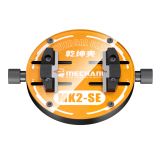 Board holder (mounting table) Mechanic MK2 SEout of stock›
Fume extraction while soldering
Flux fume contains particles and vapours you should not breathe in. The UK Health and Safety Executive links rosin-based flux fume to occupational asthma and recommends local exhaust ventilation that captures the fume at the source. A filtered bench extractor works best when its intake sits close to the joint, so place the nozzle near the soldering point without blocking your view or the path of the iron.
A bench extractor does not replace general ventilation of the room, and HSE notes that recirculating filter units may remove only part of the harmful fume, so they suit occasional, low-volume soldering better than all-day work. Replace filters on the schedule in the manufacturer's instructions. If suction drops or smoke drifts past the nozzle, stop and fix the cause before you carry on. For the wider set of rules that apply around the bench, see our guide to safety in an electronics repair workshop.
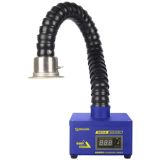 Air purifier Mechanic iSmoke CF1out of stock›
Keeping tools in order
Screwdrivers and tweezers left lying on the bench roll around, get mixed up and can damage their tips. An organizer keeps them in the same order every day and clears the middle of the bench. Choose one with slots that fit the diameters of your tools and a base heavy enough that it does not tip when you pull a tool out.
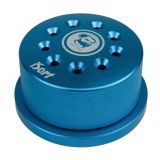 Organizer Mechanic iSort (Screwdrivers / Tweezers)out of stock›
Work lighting and the UV lamp
Light from the side or from above makes dust and fingerprints easier to spot before you bond glass or fit a new screen. Checking solder joints and fine pins needs magnification as well; our article on choosing a microscope for electronics repair explains what to look for.
Use a UV lamp only for the jobs listed in its instructions, such as curing UV adhesives or UV-curing coatings. Do not look straight into the light and do not point it at bare skin. Take exposure time and distance from the instructions for the lamp and for the material you are curing.
How to lay out the bench
- Keep the centre clear for the phone, the mat and the main operation.
- Place the board holder so your wrists have support and the jaws stay clear of components.
- Aim the light from the side or from above and get rid of glare on the screen.
- Put the extractor intake close to the smoke source without blocking your view or the tool path.
- Route cables away from the hot zone, cutting tools and the area where your hands move.
- Set aside labelled compartments for screws, removed modules and the parts of each job.
If you are equipping a workshop from scratch, see our comparison of core equipment for phone repair, which covers the microscope, fume extraction and a battery programmer.
ESD protection at the bench
An "antistatic" label on a mat does not make the workplace ESD-safe by itself. Standards such as IEC 61340-5-1 treat ESD protection as a system: the mat, the grounding point and the other protective items have to be compatible, connected as the manufacturer specifies and checked under your shop's procedure. If there is no defined grounding point or way to test it, do not improvise a connection.
Weekly bench checklist
- Mat and compartments: the surface is clean and parts from different jobs are not mixed. Move any unlabelled parts to a separate tray until you identify them.
- Board holder: the jaws move without play and leave no marks on the board. Stop using a loose or bent holder until it is repaired or replaced.
- Cables and power: insulation is intact, with no overheating or loose connections. Unplug any faulty equipment.
- Fume extraction: the airflow captures smoke and the filter is within its service interval. If not, clean or replace it as the instructions say.
- Light and UV lamp: housing, cable, switch and protective parts are in good condition. Stop using the lamp at the first sign of damage.
Conclusion
A useful accessory solves a specific problem in your workflow. Start with the operation and its risk, then check compatibility and a safe position on the bench, and once it is set up, confirm it does the job you bought it for. That way you get a comfortable bench without paying for gear you never use.

 UA
 RO








The information below is required for social login
Sign In
Create New Account