Useful information
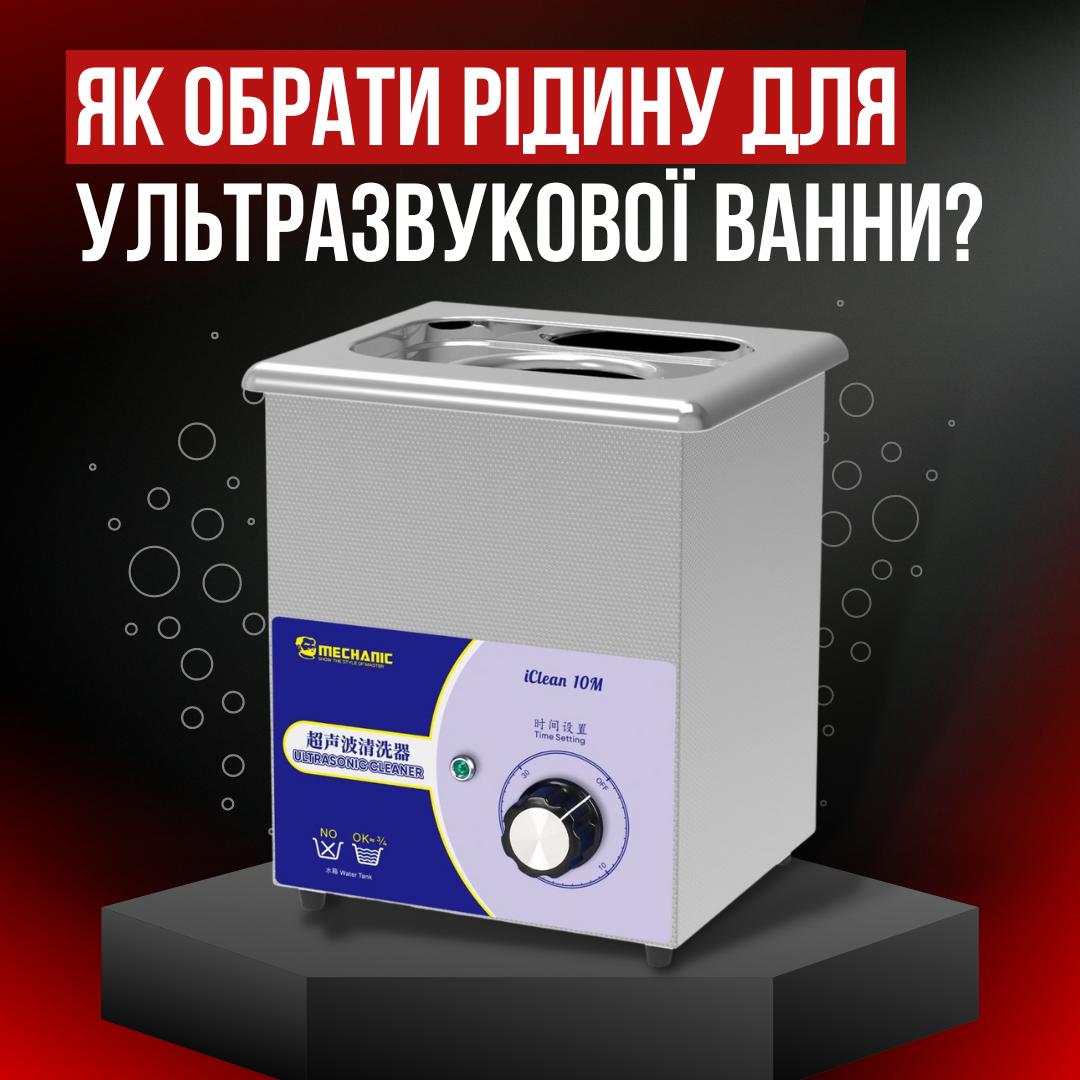
How to choose a liquid for an ultrasonic bath? — a practical article with explanations and recommendations for technicians, service centers, and users. It highlights the main points to consider when choosing, using, or repairing devices.
Choosing a fluid for an ultrasonic cleaner comes down to three conditions that all have to be true at once: the cleaner's manufacturer allows it, the materials of the part can take it, and it actually dissolves the dirt you need to remove. "For circuit boards" on a label does not automatically mean the fluid can go in the tank, and a solvent that evaporates quickly is not safe in an open tank just because it dries fast.
Four questions to answer first
| Question | What it tells you | Risk of getting it wrong |
|---|
| What are you cleaning? | Metals, plastics, coatings, adhesives, seals, components | Dull spots, corrosion, swollen plastic, parts coming unglued |
| What are you removing? | Flux, oil, dust, corrosion after liquid damage | Poor cleaning, or a fluid far harsher than the job needs |
| Which cleaner do you have? | Tank material, heater, lid, ventilation, fluids the manual prohibits | Fire, damage to the cleaner, hazardous vapours |
| What happens after the cycle? | Rinsing, drying, inspection, residue check | Moisture or residue left under components |
The main safety rule
Do not pour petrol, acetone, isopropyl alcohol or any other flammable liquid straight into a standard ultrasonic cleaner. Cavitation and heating speed up evaporation, and the vapour can ignite. A typical workshop cleaner is not explosion-proof equipment. The only exception is a process and a unit that the manufacturers of both the cleaner and the fluid explicitly approve in their documentation.
The tank material matters too. The cleaner's manual lists the agents you must not use; concentrated acids and strong alkaline solutions can attack stainless steel and the welds of the tank, and some solvents damage plastic housings and lids. The fluid's safety data sheet (SDS) tells you its composition, hazards, the ventilation it needs and the protective equipment to wear.
Fluid types used in repair shops
Water-based ultrasonic cleaning concentrates are usually the first choice for a standard cleaner. You dilute them with water in the ratio on the label, and the surfactants they contain loosen flux and grease. Afterwards the part is rinsed, usually in deionised or distilled water, so no residue or mineral deposits are left behind.
Solvent-based board cleaners are meant for wiping, brushing or local soaking. The store's product pages describe both examples below as fluids for removing flux residue and OCA from boards, and the N880 page also mentions oxidation. Being on this list does not mean they can go into the tank: read the instructions and the SDS, and look for explicit approval for ultrasonic use first.
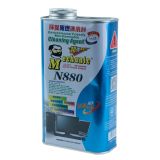 Mechanic N880 board cleaning fluid 850ml (Nonflammable, antistatic)out of stock›
The catalogue lists the Mechanic 850 Pro as a liquid for cleaning boards and for ultrasonic baths, and its page describes a highly active solvent for rosin, flux and OCA residue. Treat that listing as a starting point rather than an approval: confirm in its SDS and in your cleaner's manual that this fluid is permitted for your specific tank.
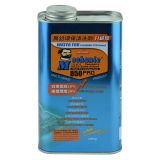 Liquid for cleaning boards / ultrasonic bath Mechanic 850 Pro 850ml (Highly active, antistatic)out of stock›
Plain water will not remove flux or grease, but it is useful for rinsing and for test runs. Tap water can leave deposits on boards as it dries.
Concentration, temperature and cycle time
There are no universal numbers. Take the concentration, temperature, cycle time and any need for degassing from the instructions for the concentrate and the cleaner. Start with the gentlest settings allowed and test on a sample part. A solution that is too weak leaves the dirt in place; one that is too strong or too hot can strip markings and damage plastics and coatings. Do not set parts directly on the bottom of the tank if the manufacturer specifies a basket.
Keep the fluid level between the manufacturer's marks. Below the minimum, the transducers run in poor conditions and cleaning becomes uneven. Change the fluid when it turns cloudy or results get worse, and dispose of it as the SDS says, not down the sink.
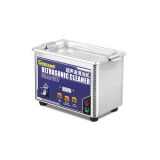 Ultrasonic Bath Mechanic iClean E08-P (0.8l)out of stock›
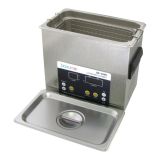 Baku BK-2000 ultrasonic bath with liquid degassing function (3.2L, 120W, 40 kHz, heating up to 80 degrees C, timer up to 99 minutes)146,50 $›
Can you clean a phone board in an ultrasonic cleaner?
Only immerse a board if its design, the repair documentation and the chosen fluid all allow it. Before cleaning, disconnect the battery and remove everything that must not be submerged: cameras, the display, microphones, speakers, modules with cavities and other sensitive assemblies. After the cycle, rinse the board as the fluid manufacturer specifies, dry it completely and inspect it under magnification. Power it up only once you have confirmed the board is dry, the contacts are clean and no residue is left. Our guide to choosing a microscope for electronics repair explains what magnification helps with solder joints and fine pins.
Step-by-step order
- Identify the materials of the part and the type of contamination.
- Read the cleaner's manual, the fluid label and the SDS.
- Remove incompatible components and run a test on a sample part.
- Mix the solution at the recommended concentration.
- Check the fluid level against the manufacturer's marks.
- Run an approved program without exceeding the time and temperature limits.
- Rinse and dry the part as the fluid's process requires.
- Inspect and test the board before you apply power.
Where to keep the cleaner in the workshop
An ultrasonic cleaner often shares a bench with the soldering station and fume extraction, so keep it away from heat sources and sockets, with room to open the lid. How to organise the rest of the bench, and which accessories make repairs easier, is covered in our article on phone repair bench accessories. Before you bring solvents onto that bench, also read our guide to safety in an electronics repair workshop.
Conclusion
The right fluid has to be approved for both the cleaner and the part. Check the SDS, keep flammable solvents out of the tank unless both manufacturers explicitly allow them, stick to the recommended concentration and finish every cycle with rinsing, drying and inspection. If you are not sure which fluid suits your equipment, the GSM-Forsage team can help you choose.

 UA
 RO





The information below is required for social login
Sign In
Create New Account