Useful information
How to protect equipment from power surges. — a practical article with explanations and recommendations for technicians, service centers, and users. It highlights the main points to consider when choosing, using, or repairing devices.
A single bad power event can kill a TV, a router, a gaming PC or the power supply of a washing machine. We first published these tips in March 2023, after a winter in which many of our readers in Ukraine lived with scheduled outages and unstable mains caused by attacks on the power grid. In October 2026 we rewrote the article: the advice is now organised by the type of problem, because each protective device handles only part of the risk.
What actually damages equipment
"Power surge" is used for several different events. It helps to separate them, because the right protection depends on which one you face:
- Transient surges (spikes). Very short pulses lasting microseconds to milliseconds, caused by nearby lightning, switching of large loads or the grid itself. They are fast and high, but carry limited energy.
- Sustained overvoltage. The voltage stays too high for seconds or minutes. A classic cause is a broken neutral conductor in a three-phase building supply: single-phase sockets can then see voltages far above 230 V, sometimes approaching the 400 V between phases.
- Undervoltage (brownouts). The voltage sags well below normal. Motors in fridges, pumps and air conditioners draw more current and overheat, and some power supplies cycle on and off.
- Outages and the moment power returns. When the supply comes back, many devices start at once, and the first seconds can bring unstable voltage.
For reference, the European standard EN 50160 describes a normal public supply as 230 V with slow voltage variations kept within plus or minus 10% for 95% of the time over a week. Anything outside that range for longer periods is a problem for your appliances.
Unplug what you are not using
The cheapest protection still works. A device that is not connected cannot be damaged. Unplug rarely used appliances, chargers and the TV when you leave home for a long time. The US National Weather Service also notes that lightning can induce current in wiring and damage electronics, so unplug sensitive equipment before a thunderstorm arrives, not during it.
During an outage, switch off or unplug expensive equipment and leave one lamp switched on so you know when power is back. Then plug things back in one by one instead of all at once.
Surge protector: for short spikes only
A surge protector (a power strip or adapter with a surge protective device, usually built on varistors) diverts short spikes to earth or absorbs them. It is useful for a TV, computer, router and chargers. Keep its limits in mind:
- It does not regulate voltage and cannot protect against a sustained overvoltage such as a broken neutral. In that case the protective components themselves can overheat and fail.
- It needs a properly earthed socket to work as designed.
- Varistors wear with every large surge. If the strip has a "protected" indicator and it goes out, replace the strip.
- An ordinary extension lead with an on/off switch is not a surge protector, even if it looks similar. Check the packaging for a stated surge rating.
In buildings, electricians can also install surge protective devices in the distribution board. The IEC 61643-11 standard defines Type 1, Type 2 and Type 3 devices for different points of the installation, and they work best as a coordinated set. This is a job for a qualified electrician.
Voltage monitoring relay: for over- and undervoltage
A voltage monitoring relay (often sold as a "voltage relay" or "voltage protector") is fitted in the distribution board or plugged into a socket. When the voltage goes above or below the limits you set, it disconnects the load, and it reconnects automatically after a delay once the voltage is back to normal. This is the device that protects a home against a broken neutral and deep sags.
Before buying, check in the datasheet:
- the adjustable upper and lower thresholds and the reconnect delay (fridges and air conditioners need a delay of a few minutes so the compressor can restart safely);
- the rated current, which must match the circuit breaker and your total load;
- the installation type: a DIN-rail relay for the whole flat or house is installed by an electrician, a plug-in version protects one appliance.
A relay disconnects power when something is wrong. It does not raise low voltage, and it does not catch microsecond spikes, so it pairs well with surge protection.
Voltage stabiliser: when the voltage is constantly off
A stabiliser (automatic voltage regulator) makes sense when your mains is regularly too low or too high, which is common at the end of long rural lines or in older private houses. It keeps output voltage close to 230 V within its input range. The main types are relay, servo (electromechanical) and electronic models. They differ in speed, accuracy and noise.
Size it with a margin over the total power of the appliances connected to it, and allow for motor start-up currents. A stabiliser is not a substitute for a voltage relay: outside its input range it can only switch off, and a cheap unit that fails leaves the load unprotected.
UPS: for outages and clean shutdown
An uninterruptible power supply (UPS) keeps equipment running from its battery when the mains fails. The IEC 62040-3 standard divides UPS units into three classes:
| Type | IEC 62040-3 class | How it works | Typical use |
|---|
| Offline (standby) | VFD | Passes mains through; switches to battery when it fails | Home PC, simple office equipment |
| Line-interactive | VI | Corrects moderate voltage deviations with a regulator, battery for outages | PCs, NAS, network equipment where voltage drifts |
| Online (double conversion) | VFI | Constantly rebuilds the output from DC, so output does not depend on mains | Servers, sensitive equipment, unstable supply |
If a manual says the load needs a pure sine wave (gas boiler makers often require this for the circulation pump), choose a UPS with sine wave output. For computers, the point of a UPS is often a clean shutdown and saved work, rather than hours of autonomy.
To keep the internet up during outages, consider a small DC UPS for a router. It powers the router or fibre terminal directly through 5, 9 or 12 V outputs from its built-in battery. Check that the output voltage and connector match your router's power adapter before you buy.
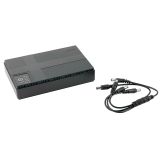 Uninterruptible power supply (UPS) for router DC10118P (5-9-12V / 10000mAh / 18W) Black31,00 $›
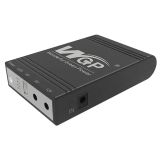 Uninterruptible power supply (UPS) for router WGP103 (5-9-12V / 10400 mAh) Black28,63 $›
A power bank can do a similar job for phones and small devices. Our guide on how to use a power bank correctly covers charging habits that extend its life.
Which protection for which device
| Device | Sensible minimum | Add if needed |
|---|
| Fridge, washing machine, air conditioner | Voltage relay (for the whole home or per appliance) | Stabiliser if voltage is regularly low |
| TV, audio, games console | Surge protector power strip | Voltage relay at home level |
| Desktop PC, NAS | Line-interactive UPS | Online UPS for critical work |
| Router, fibre terminal | DC router UPS or small UPS | Surge protector on the mains side |
| Gas boiler | UPS with pure sine wave output | Stabiliser if the boiler maker requires it |
For a repair bench
A workshop has the same risks plus expensive tools such as soldering stations, hot air stations and bench power supplies. Put the bench on a circuit with a voltage relay, use a surge protector strip for the tools, and keep a UPS for the PC that holds your repair records. Our article on how to arrange a repair workplace covers bench layout, and the workshop safety rules explain how to handle batteries and power safely.
Quick checklist
- Find out what problem you have: spikes, constant low or high voltage, or outages.
- Install a voltage relay for the home or the most expensive appliances.
- Plug electronics into a surge protector with a proper earth, and replace it if the protection indicator goes out.
- Use a stabiliser only if the voltage is regularly outside the normal range.
- Choose a UPS by load and type: line-interactive for most PCs, online or pure sine wave where the equipment requires it.
- Unplug sensitive equipment before storms and during long absences.

 UA
 RO






The information below is required for social login
Sign In
Create New Account