Useful information
What sprays and liquids does the craftsman need? — a practical article with explanations and recommendations for technicians, service centers, and users. It highlights the main points to consider when choosing, using, or repairing devices.
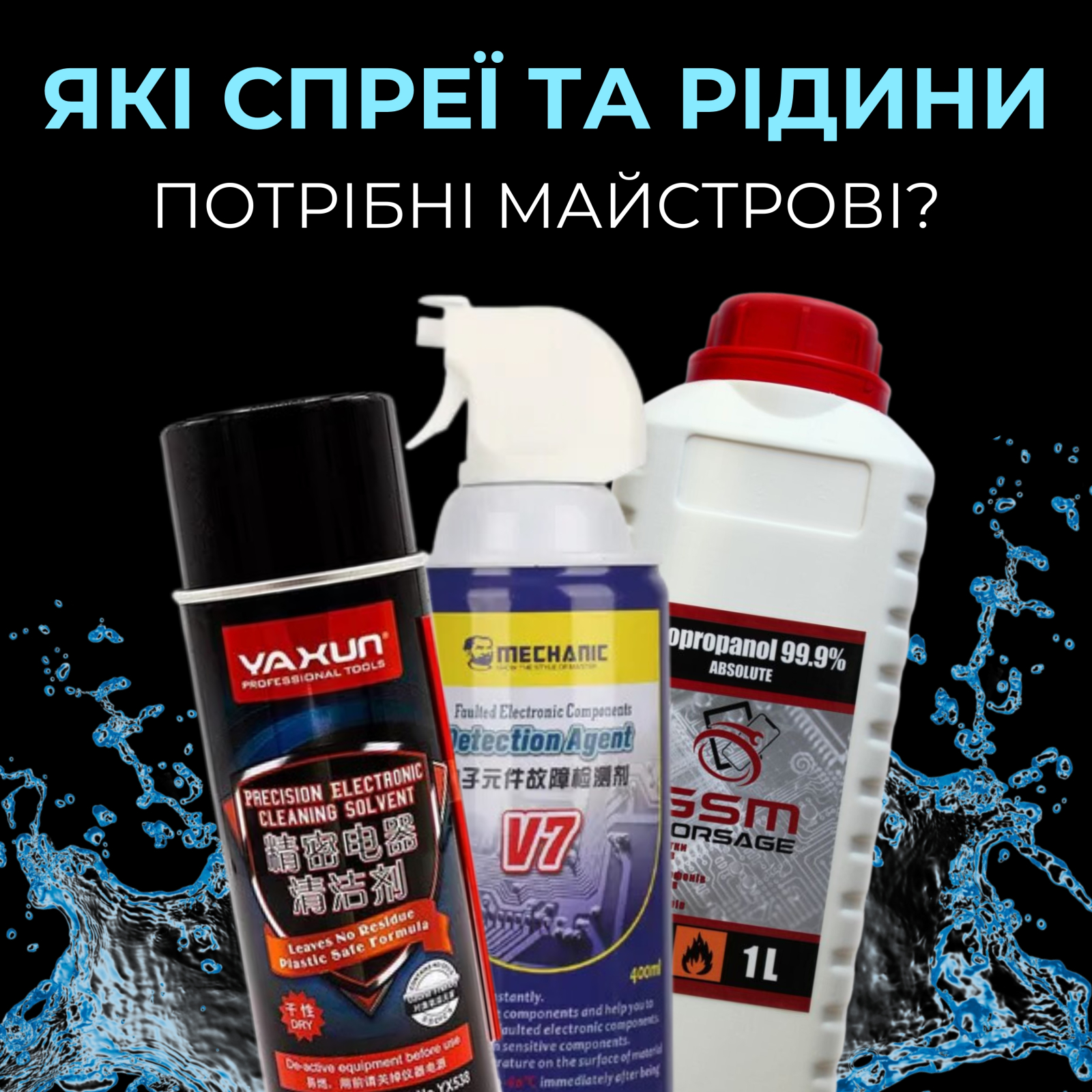
A repair bench needs several chemicals, each matched to a job: cleaning flux off a board, degreasing a frame, removing OCA from a display, softening housing adhesive and spotting a hot component with freeze spray. Pick the product for the task and the material around it, read the label and safety data sheet, and test on a hidden spot before the first real repair.
Which liquid fits which repair job
| Job | Type of product | Main risk |
|---|
| Cleaning flux off a PCB | Electronics cleaner compatible with the board, or high-purity isopropyl alcohol | Residue, dissolved component markings, liquid creeping under shields and into connectors |
| Degreasing a frame before gluing | A product approved for that frame material and coating | Clouded plastic, stripped paint, a damaged gasket |
| Removing OCA from a display | Dedicated OCA remover, liquid or spray | Contact with the polarizer, backlight, flex cables or skin |
| Softening frame or back cover adhesive | Adhesive remover made for frames and back covers | Damage to paint, plastic, cameras and sensors |
| Finding a component that heats up | Diagnostic freeze spray | Condensation, thermal shock, a flammable aerosol, misreading the result |
Isopropyl alcohol: where it makes sense
Many technicians reach for isopropyl alcohol (IPA) when cleaning unpowered boards, tools and many metal surfaces. Purity matters: the more water and impurities it contains, the slower it dries and the more residue it can leave. A product with some water in it is not automatically useless, but you need to give it more time and check the area more carefully before power goes back on.
IPA is not safe for every plastic or coating. Check the product label and the material manufacturer's guidance first, then try it on a spot nobody will see. Do not power the device until the liquid has fully evaporated.
Board and contact cleaners
A dedicated electronics cleaner can dissolve a particular flux or type of dirt better than plain alcohol. Whether it is safe for nearby materials and whether it leaves residue are things to confirm in the technical data, not to assume. Keep the aerosol jet away from microphones, cameras, display layers and sealed parts unless you really need to clean there.
Inspect the board under magnification after cleaning. Dissolved flux often just moves to a connector or under a shield. If your bench also has an ultrasonic bath, the guide on choosing an ultrasonic cleaner fluid covers which solutions belong in the tank and which do not.
OCA removers and housing adhesive removers
An OCA remover is made for the optical adhesive left behind during display refurbishing. A frame or back cover adhesive remover does a different job. Both soften glue, but that does not make them interchangeable.
Use the smallest controlled amount, protect flex cables and openings, and collect the used liquid instead of spreading it across the mat. The same habits apply to the rest of your consumables, which are covered in the article on soldering consumables.
Freeze spray for diagnostics
A short burst of cold shows where frost melts first, or how a circuit reacts when one part is cooled. That is a diagnostic hint, not proof. The spot that warms up shows where current flows, but it does not tell you which component caused the fault.
Use short, controlled bursts as the instructions describe. Expect condensation, keep in mind that some materials turn brittle when cooled quickly, and treat the can as flammable if the label says so. Never spray it near an open flame or a hot iron.
Examples from the GSM-Forsage catalog
The product cards below show current details. Check the composition, application method and limitations on the label of the exact product you buy.
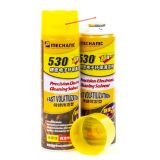 Mechanic 530 Sensitive Electronics Cleaning Spray (600 ml.) (Yellow)4,91 $›
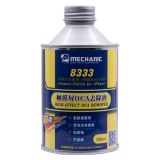 Fluid for removing OCA Mechanic 8333 (300 ml)5,04 $›
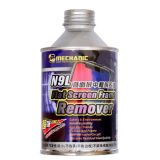 Mechanic N9L frame glue remover (300 ml)5,41 $›
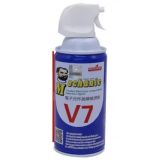 Spray freezing Mechanic V7 (400 ml)out of stock›
A safe working sequence
- Identify the contamination and the materials around it.
- Read the label and the safety data sheet, then set up ventilation and protective gear to match.
- Switch the device off, disconnect power and, where needed, disconnect the battery following the service procedure.
- Run a compatibility test on a hidden area or a spare part.
- Apply the smallest amount that does the job with a dispenser, wipe or brush suited to the process.
- Remove the dissolved dirt instead of just spreading it around.
- Wait for full evaporation, inspect the area and only then reconnect power.
The wider picture of bench safety, including solvents, solder fume and damaged batteries, is in our phone repair workshop safety rules.
Storage and labelling
- Keep each product in its original labelled container with the cap tightly closed.
- Never decant chemicals into drink bottles or leave a container without a label.
- Write the opening date on the container if the manufacturer limits shelf life after opening.
- Store away from heat, direct sunlight, ignition sources and incompatible substances.
- Do not puncture aerosol cans, and dispose of cans and waste according to local rules.
Bottom line
Board cleaner, contact cleaner, OCA remover, adhesive remover and freeze spray each have their own job. Choose by material and type of contamination, test compatibility, work on a powered-down device and keep the room ventilated. A "universal" label on the can does not replace the instructions or a test on the actual surface.

 UA
 RO




The information below is required for social login
Sign In
Create New Account