Useful information
What consumables are needed for soldering? — a practical article with explanations and recommendations for technicians, service centers, and users. It highlights the main points to consider when choosing, using, or repairing devices.
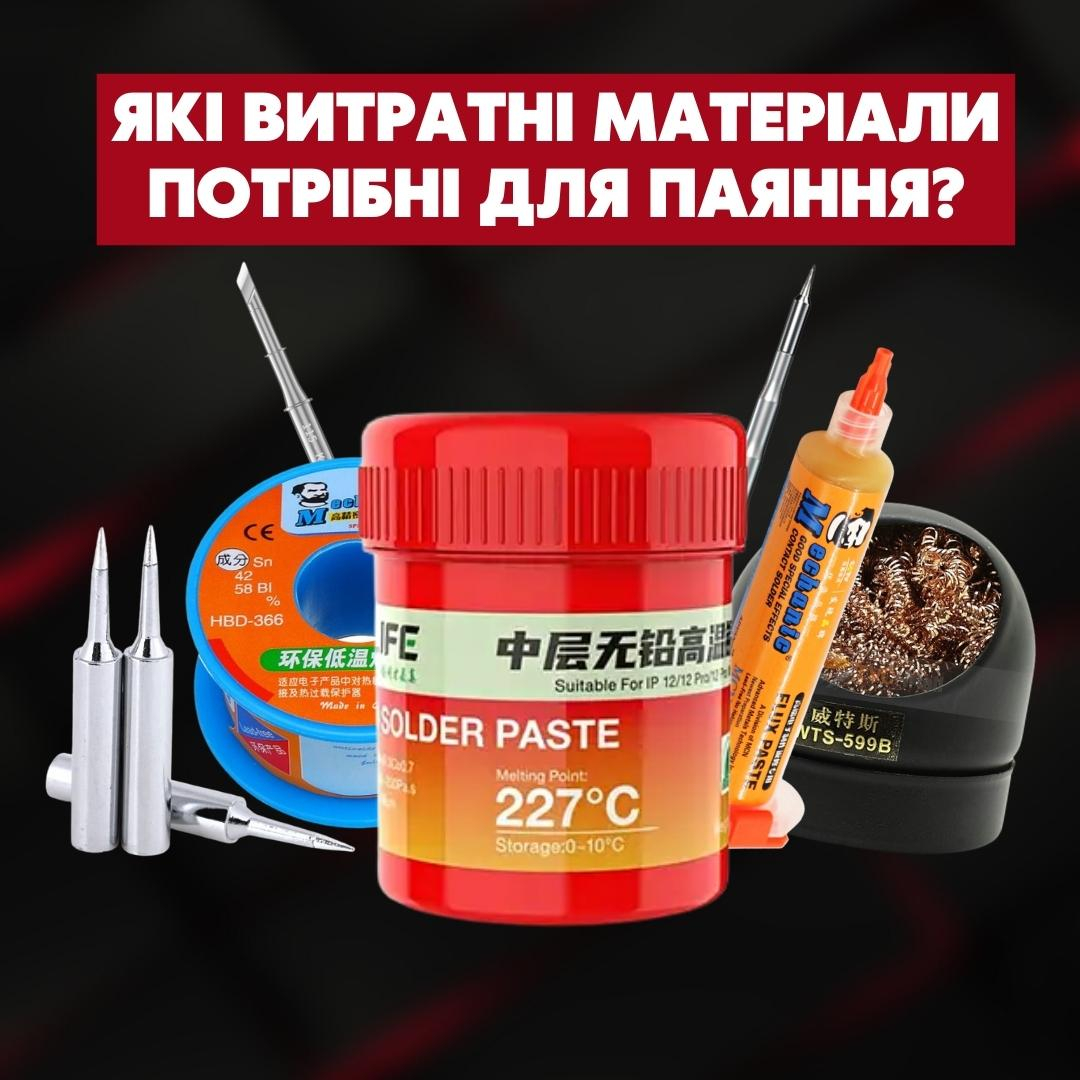
For everyday electronics and phone repair you need five consumables: solder wire, flux, desoldering braid, soldering iron tips that fit your station, and something to clean the board afterwards. Board-level work such as BGA reballing or SMD rework adds solder paste, stencils, solder balls and heat-resistant tape. None of these are universal. Each one has to match the solder alloy on the board, the size of the joint, the component and the way you apply heat.
Soldering consumables at a glance
| Consumable | What it does | What to check before buying |
|---|
| Solder wire | Forms the metal joint between the pad and the lead | Alloy (leaded or lead-free), wire diameter, flux core |
| Flux | Removes oxides and helps molten solder wet the surfaces | Flux type and activity, whether residues must be cleaned off, safety data sheet |
| Desoldering braid | Soaks up molten solder from pads and pins | Width, whether it is pre-fluxed, how well it wicks |
| Solder paste | Puts a measured amount of solder powder and flux exactly where you need it | Alloy, powder size, storage temperature, shelf life, reflow profile |
| Soldering iron tips | Carry heat from the iron into the joint | Fit with your handpiece, shape and size, condition of the plating |
| Board cleaner | Removes flux residue and dirt that the cleaner is designed for | Compatibility with plastics, coatings and markings; ventilation |
How to choose solder wire
Start with the alloy already on the board. Traditional tin-lead solder (Sn63/Pb37) melts at 183 °C. Common lead-free alloys such as SAC305 (tin, silver, copper) melt at roughly 217 to 220 °C, so they need more heat and wet a little more slowly. Most electronics sold in the EU since 2006 is built with lead-free solder because the RoHS directive restricts lead, although some product categories have exemptions. In repair work, mixing alloys on one joint is best avoided, and the original assembly process tells you which alloy you are dealing with.
Wire diameter is about control, not quality. Thin wire around 0.3 to 0.5 mm makes it easier to feed a small amount of solder onto fine-pitch pins and 0402 parts, while thicker wire suits connectors, cable joints and large ground pads. A flux core helps, but it does not always remove the need for separate flux, especially when you rework a joint that has already been heated several times.
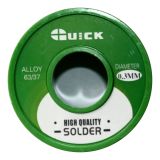 Solder Quick 0.3 mm (45g)1,79 $›
How to choose flux
Flux strips the oxide film from metal surfaces so that solder can flow and bond. The IPC J-STD-004 standard sorts fluxes by base material (rosin, resin, organic or inorganic) and by activity (low, moderate or high), with a code that also shows whether halides are present. Labels such as ROL0 or REL0 describe a rosin or resin flux with low activity and no halides. Highly active fluxes clean aggressively but leave residues that can corrode a board if they stay on it.
"No-clean" means the residue is designed to be left on the board under the conditions the manufacturer specifies. It does not mean the flux is safe on any board in any quantity, and heavy or partly burnt residue can still cause leakage or contamination. Use the smallest amount that does the job, read the manufacturer's cleaning guidance and safety data sheet, and work with fume extraction. Gel flux in a syringe is popular for phone repair because it stays where you put it during hot-air work.
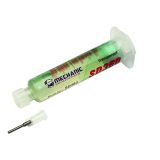 Flux Mechanic SD360 10cc (in syringes)5,19 $›
Desoldering braid
Desoldering braid (also called solder wick) is woven copper wire, usually pre-treated with flux. Lay it on the joint, press the iron tip on top and let capillary action draw the molten solder into the copper. Lift the braid and iron together while the solder is still molten, and cut off the used section. Braid removes molten solder only. It does not remove flux residue, and dragging it across a pad or pressing hard can lift the pad from the board.
Match the width to the job. Narrow braid around 1.5 to 2 mm suits small pads and pins on phone boards, while wider braid clears larger areas faster but takes more heat. Adding a little fresh flux makes almost any braid wick better.
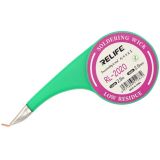 Braid (for removing solder) RELIFE RL-2020 (2.0mm)4,40 $›
Soldering iron tips
Modern tips have a copper core for heat transfer and an iron plating that protects the copper from being dissolved by molten solder. The plating is what makes a tip last, so never file or sand it. Clean it with brass wool or a damp sponge, and leave a thin layer of solder on the tip when you put the iron back in the stand.
Choose the shape by the size of the joint. A fine conical tip reaches small pins, but its small thermal mass can struggle to heat a large pad, which tempts you to raise the temperature instead. Chisel, bevel and knife-shaped tips carry more heat into large pads and are good for drag soldering rows of pins. Tips are made for a specific handpiece standard, so check that a tip fits your station before you order it. If you are still choosing the station itself, our guide to professional soldering stations for phone repair compares the main types.
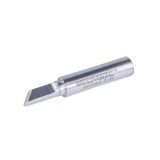 Mechanic Superfine 900M-TK soldering iron tip (Spatula, straight)3,29 $›
Solder paste and BGA consumables
Solder paste is fine solder powder suspended in flux. It lets you apply a controlled amount of solder to pads or through a stencil, which is why it is used for SMD rework and BGA reballing. Paste is graded by alloy and powder particle size, and many pastes need refrigerated storage. Follow the label: let a cold jar or syringe reach room temperature before opening it, note the opening date and stay within the shelf life. For reballing you will also need stencils for the specific chip, solder balls of the right diameter and heat-resistant tape to protect nearby parts.
Cleaning the board after soldering
Isopropyl alcohol is the usual first choice for removing flux residue, applied with a lint-free wipe or an ESD-safe brush. Specialist flux removers work faster on stubborn residue, but check that they are safe for the plastics, coatings and printed markings on the board. Our overview of sprays and liquids for repair technicians explains which cleaners suit which job.
A safe soldering workflow
- Identify the alloy, the component and the heat it can tolerate.
- Choose a tip or hot-air nozzle that matches the size of the joint.
- Clean and secure the board, and set up ESD protection and fume extraction.
- Apply a small, controlled amount of flux and solder.
- Heat the joint only until the solder wets both surfaces and forms a smooth fillet, staying within the limits for the component.
- Inspect the joint under magnification and remove residue if the process requires it.
- Check for solder bridges and short circuits before you apply power.
Storage and safety
- Keep consumables in their original labelled containers and store them as the label and safety data sheet direct.
- Write the opening date and batch on pastes and fluxes, and set aside anything you cannot identify.
- Use fume extraction. The UK Health and Safety Executive lists rosin-based solder flux fume as a cause of occupational asthma.
- Pick gloves and eye protection based on the safety data sheet for the product you are using.
- After handling leaded solder, wash your hands and do not eat or drink at the bench.
Fume, ESD and battery hazards are covered in more depth in our phone repair workshop safety rules.
Weekly checklist
- Check stock of solder, flux and braid.
- Inspect tips, brass wool or sponges, and iron stands.
- Review expiry dates, opening dates and storage conditions.
- Move unlabelled materials to a separate area until they are identified.
- Clean the fume extractor filter and the work surface according to your workshop routine.
Summary
Soldering consumables work as a set. Solder makes the joint, flux lets it wet properly, braid removes excess solder, the tip delivers heat, and a compatible cleaner removes residue the process should not leave behind. Match them to each other and to the board, keep the heat under control, ventilate the bench and check every joint under magnification before power goes on.

 UA
 RO





The information below is required for social login
Sign In
Create New Account