Useful information
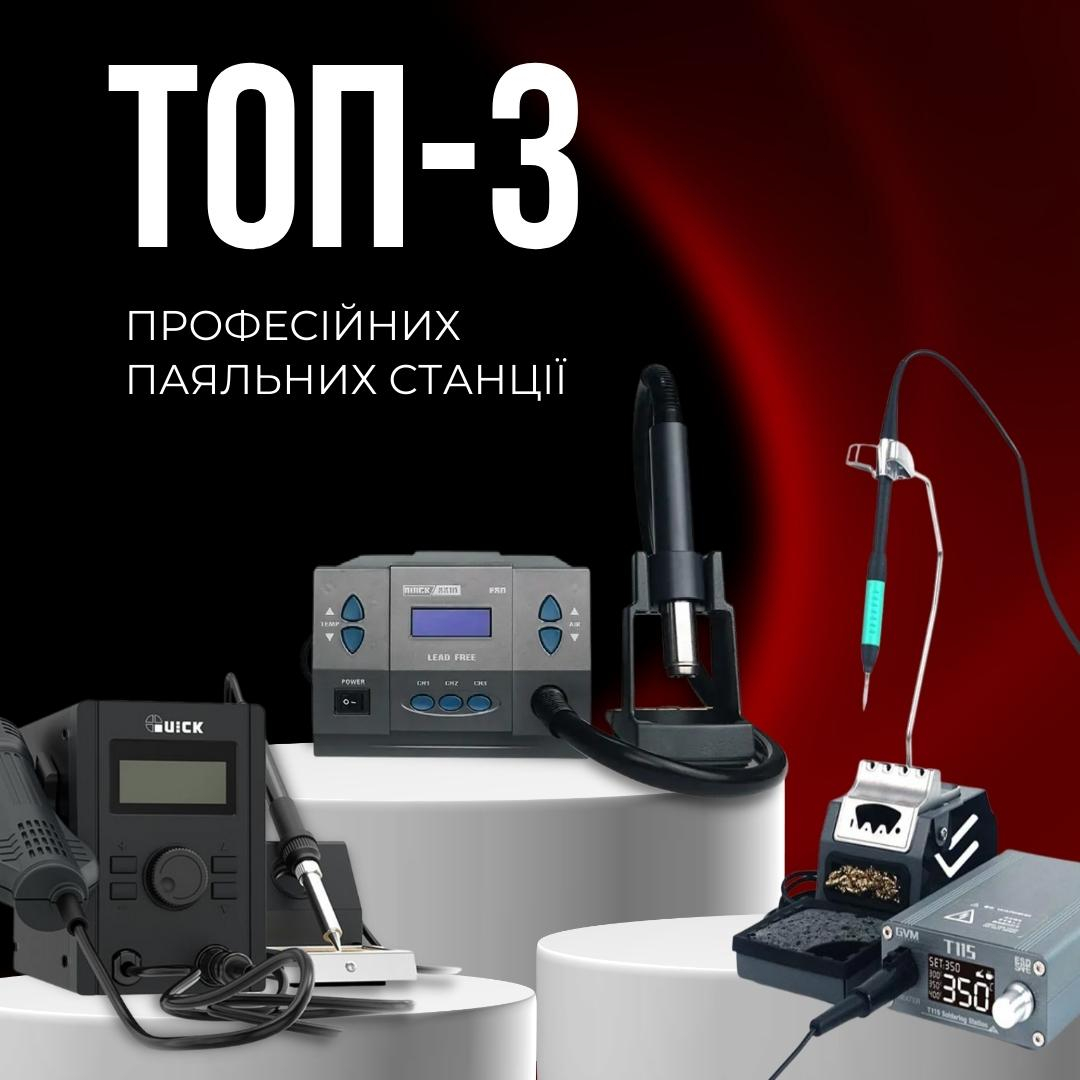
TOP-3 professional soldering stations. — a practical article with explanations and recommendations for technicians, service centers, and users. It highlights the main points to consider when choosing, using, or repairing devices.
In a phone repair shop, "professional soldering station" usually covers three kinds of equipment: a contact station with a soldering iron, a standalone hot air station, and a 2-in-1 unit that puts both tools in one housing. Which one you need depends on the jobs you do every day, the space on your bench and how often you switch between the iron and hot air.
This article first appeared in August 2023 as a pick of three models: GVM T115 / C115, QUICK 715 2 in 1 and QUICK 881D. We rewrote it in October 2026. The three station types stay, the advertising claims are gone, and the only specifications quoted are the ones in the product names in the GSM-Forsage catalog. It is not a ranking, and we did not run our own tests on these units.
Three station types and what each one is for
| Type | Typical jobs | What to check before buying |
|---|
| Soldering iron (contact station) | Connectors, wires, pads, small SMD parts, cleaning pads with desoldering wick | Tip system, how quickly the tip recovers on a large joint, tip grounding |
| Standalone hot air station | Removing and fitting chips, heating an area, working with nozzles | Separate temperature and airflow control, available nozzles, automatic cool-down of the handpiece |
| 2-in-1 combo station | Small benches or mixed work where you use both tools in turn | Whether the two channels are controlled independently, spare parts for both handpieces |
Contact station: GVM T115 / C115
For iron work on phone boards, the tip system matters more than the rated power. The name GVM T115 / C115 tells you the station takes C115-type tips, a small format used for fine joints on densely populated boards. Its catalog listing gives a range of 120-450°C and 45 W.
A station like this makes sense if you solder a lot under a microscope: display connectors, battery contacts, small resistors and capacitors. On heavy joints, such as a metal shield or a large copper pour, a small tip may not be enough. There you need a wider tip or preheating with hot air.
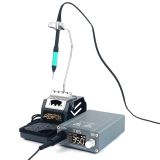 GVM T115 / C115 soldering station63,85 $›
Before you buy, check which tip shapes exist for the system and whether you can order them later. The tip is the part that wears out fastest, and a station you cannot get tips for soon ends up in a drawer.
Hot air station: when a separate unit makes sense
You need hot air when several terminals have to be heated at once: a chip, a connector with many pins, an area packed with small parts. A separate station is handy if you already own a good soldering iron and want to run both tools side by side without tying them to one housing.
The 2023 pick included the QUICK 881D, listed in the catalog at 100-500°C, 120 l/min and 1300 W. Another option in the catalog is the Mechanic Air Nova, rated at 100-500°C and 1200 W according to its product name. Availability changes, so check the product page before ordering.
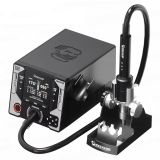 Mechanic Air Nova hot air stationout of stock›
The maximum temperature figure says little about how a station behaves in real work. In a repair shop you want separate control of temperature and airflow, nozzles in several sizes, and a handpiece that goes into cool-down by itself when you put it on the stand. On phone boards, too much airflow can blow away the small parts around the area you are working on.
2-in-1 combo station
A 2-in-1 station has the soldering iron and the hot air gun in one unit. It takes up less room and needs a single power cable, which helps on a small bench. On the other hand, if the housing or the power supply fails, you lose both tools at once.
In the original article we featured the QUICK 715 2 in 1, which the catalog describes with hot air at 100-500°C, 120 l/min and 700 W, plus a soldering iron at 100-480°C and 60 W. Another QUICK 2-in-1 model in the catalog is the QUICK 705 ESD+FAN, with 750 W, hot air at 100-450°C and a soldering iron at 200-480°C, going by its catalog name.
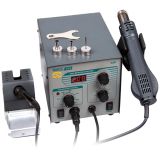 QUICK 705 ESD+FAN 2-in-1 station106,41 $›
With a combo station, ask two questions: can you use the iron and the hot air at the same time with separate settings, and can you buy the handpiece, heating element and nozzles separately? If both answers are yes, a station like this can cover almost all routine jobs in a phone repair shop.
How to choose for your workshop
- Write down the jobs you do most often in a typical week: connectors, batteries, chips, trace repairs.
- Split them into iron work and hot air work. If most of it is iron work, start with a good contact station.
- When you use hot air a lot, choose between a separate station and a 2-in-1 based on the space on your bench.
- Check which spare parts you can get: tips, nozzles, heating elements, handpieces.
- Plan the rest of the workstation: board holder, heat-resistant mat, fume extraction, good lighting.
We cover the rest of the bench equipment in a separate article on accessories that make a repair bench easier to work at. A fine tip only helps if you can see the joint clearly, so the guide to choosing a microscope for electronics repair is worth reading too.
Working safely with a soldering station
- Plug the station only into a grounded outlet and follow the manufacturer's instructions.
- Use fume extraction. Flux fumes can irritate the airways and should not be breathed in.
- Do not copy "universal" temperatures from the internet. The right settings depend on the alloy, the component, the board and the nozzle.
- Disconnect the phone battery before using hot air on the board, and keep the hot air away from the battery.
- After work, leave the hot air handpiece on its stand until the cool-down cycle finishes before switching the station off, if the manufacturer's instructions say so.
You will find more workshop rules in our article on safety rules for repair technicians.
In short
For fine iron work on phone boards, look at the tip system and how quickly the tip recovers its temperature. Removing chips needs hot air with separate temperature and airflow control. A 2-in-1 station is useful when space is tight and you use both tools. Whatever you pick, choose by the jobs you actually do and by the spare parts you will be able to buy later.

 UA
 RO





The information below is required for social login
Sign In
Create New Account