Useful information
Choosing a multimeter: characteristics and overview — a practical article with explanations and recommendations for technicians, service centers, and users. It highlights the main points to consider when choosing, using, or repairing devices.
For phone and tablet repair you need a digital multimeter that reads DC voltage and resistance reliably, has a fast continuity beeper and a diode test mode. Count rating, auto-ranging and extra functions come second. Before them, check the stated accuracy, the input protection, the quality of the test leads and how clearly the rotary switch is marked.
What a phone repair technician actually measures
At the bench a multimeter helps you check supply rails, look for signs of a short circuit, compare readings on board lines and test individual components. It is a diagnostic aid and will not name the fault for you, so every reading has to be compared with a schematic, a known-good board or the expected behaviour of the circuit.
| Task | Mode | Check before you measure | Typical mistake |
|---|
| Check a supply voltage | DC voltage (V DC) | Leads in the correct jacks, a suitable range selected | Leaving the meter in current mode or the red lead in the current jack |
| Find an open circuit | Continuity | Board unpowered, capacitors discharged | Testing a live circuit |
| Compare the resistance of a line | Resistance (ohms) | Power disconnected, test points chosen in advance | Drawing a conclusion from one unstable reading |
| Check a junction or compare lines | Diode test | Same lead polarity and the same reference points each time | Comparing readings taken under different conditions |
| Measure current | A or mA | Meter wired in series, correct jack, range and fuse rating | Connecting the meter in parallel across a source |
If you are still putting your first toolkit together, our guide on how to learn phone repair step by step has a section on which tools to buy first and where the multimeter fits in.
Accuracy, resolution and counts
The count rating describes resolution: how finely the meter can display a value on a given range. A 6000-count meter shows up to 5999 before it moves to the next range, so over a wider span of values it can show one more decimal place than a 2000-count meter. Accuracy is a separate specification. Manufacturers state it as plus or minus a percentage of the reading plus a number of digits, separately for each function and range. That is why a 6000-count meter is not automatically more accurate than a 4000-count one. Compare the accuracy figures for the modes you will use most.
For everyday board work, stable readings, a quick continuity response and a predictable diode test matter more than an extra digit. Higher resolution pays off when you really need to see small changes and you know the error limits of your meter.
Auto-ranging or manual ranging
With auto-ranging the meter is convenient when you do not know what value to expect, because the meter picks the range itself. Manual ranging settles faster during a series of identical measurements. A practical choice for a workshop is a meter that auto-ranges by default and lets you lock a range when you need to.
Test leads, jacks and input protection
Thin, sharp probe tips make it easier to land on small test points, as long as the insulation is intact. The plugs should sit firmly in the jacks, and the cable should not lose contact when it bends. If you work on boards every day, check whether the leads and fuses can be replaced separately.
Look at the jack markings, the fuse ratings and the measurement category printed on the meter and the leads. A meter bought for low-voltage electronics should not be used on mains wiring unless both its ratings and your training are suitable for that work.
Extra functions worth paying for
- HOLD freezes the reading when you cannot look at the display while holding the probes.
- REL (relative mode) subtracts a reference value, for example the resistance of the test leads.
- A backlight and a stand help on a crowded bench.
- Capacitance and temperature modes are useful only if those jobs come up regularly.
- True RMS gives correct readings of AC signals that are not clean sine waves. For basic smartphone diagnostics it is not the deciding factor.
Multimeters and test leads in our catalogue
Below are a few examples from the GSM-Forsage range. Open the product page and compare the modes, the contents of the box and current availability with the jobs you plan to do.
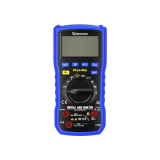 Mechanic Five MX digital multimeterout of stock›
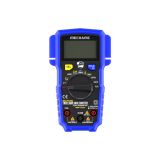 Mechanic MiniTD MX digital multimeterout of stock›
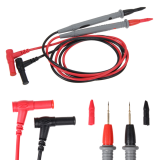 Probes for a multimeter 1000V / 20A are thin, high-qualityout of stock›
How to prepare for a measurement safely
- Inspect the case, the lead insulation and the plugs. Do not use a damaged set.
- Decide what you are measuring and roughly what value you expect.
- Put the black lead in COM and the red lead in the jack marked for the selected function.
- Select the mode and, if you are unsure, start on a higher range.
- For resistance, continuity and diode tests, remove power from the board and discharge the capacitors.
- After a current measurement, move the red lead back to the voltage jack so the next check does not start in the wrong configuration.
Measuring current means opening the circuit and connecting the meter in series. Many of these jobs involve a phone battery, so keep the handling rules from our article on workshop safety with lithium-ion batteries, solder fume and ESD in mind. Our guide on when a phone battery needs replacing explains which checks to run before you order a new one.
Multimeter buying checklist
- List your main tasks: DC voltage, resistance, continuity, diode test, current.
- Compare the accuracy for those modes, not only the count rating.
- If you can, try the continuity response and the feel of the rotary switch.
- Check the leads, the jack layout and whether fuses and batteries are easy to replace.
- Make sure the range markings are legible and the display is readable at your working angle.
- Do not pay extra for modes you have no use for.
When the meter arrives, test it on a voltage source with a known value, and check resistance and the diode test on a component you know is good. After that, use the same sequence of steps for routine measurements so your readings stay comparable.
Summary
For phone repair, choose a digital multimeter with good test leads, a fast continuity beeper, a diode test mode and clearly specified input protection. Resolution and extra functions are worth paying for only when they match the measurements you take every day. Before each connection, check the mode, the jack and whether the circuit is powered.

 UA
 RO






The information below is required for social login
Sign In
Create New Account